Two Pizzas or One Bus? Why Britain Needs Its Own Answer to the Team-Size Question
An Imported Idea, Served Cold
The two-pizza rule — Jeff Bezos's famous shorthand for keeping teams small enough to be fed by a pair of pizzas — has travelled a long way since Amazon popularised it. It now sits in slide decks from Bristol to Glasgow, quoted by managers who have never shipped a line of code and never ordered from the same takeaway twice.
There is nothing wrong with the principle. Small teams communicate faster, own more, and hide less. But the metaphor itself is telling: it assumes colleagues who order food together, in an office where dinner is a working event, in a culture where the team is expected to be the centre of social life.
That is not how most British workplaces work. And if we're going to borrow American frameworks, we should at least adapt them to British conditions.
The Full Bus Rule
Here is a homegrown alternative, offered half-seriously and meant entirely: if two colleagues cannot share a double-decker bus route and hold a proper conversation, the team is too big.
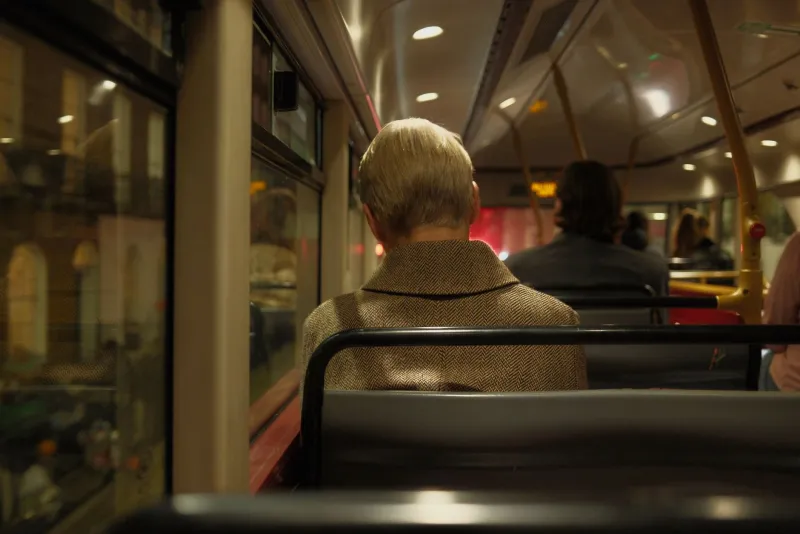
The logic is simple. A British commuter bus — the 43 through Manchester, the 25 through Cardiff, any number through any market town at 8am — imposes a natural structure on human interaction. You sit. You talk. The journey lasts twenty to forty minutes. There is time for a proper chat: not a status update, not a stand-up, but an actual conversation about the work, the weekend, and the thing that's been quietly bothering someone since Tuesday.
Now count your team. If you cannot plausibly picture any two members of it sitting together on the top deck and talking with ease, you do not have a team. You have a department. The distinction matters more than any org chart suggests.
Why Geography Changes the Maths
British working life is shaped by geography in ways the two-pizza rule never anticipated. Our offices cluster in city centres ringed by commuter belts. Our trains are expensive and unreliable. Our pubs, not our canteens, remain the default venue for honest conversation.
This changes what a workable team size looks like. In a culture where social bonding happens in small groups, in pubs with limited seating, over rounds that get unwieldy past six people, a team of twelve is not merely inefficient — it is socially incoherent. It will fragment into cliques of three and four, and the fragments will communicate through their most confident members rather than through each other.
American tech culture, by contrast, tends to assume the team can be the primary social unit. British teams rarely get that luxury, and pretending otherwise produces the familiar pattern: a big nominal team, several real micro-teams, and a quiet resentment among anyone who doesn't belong to one.
What the Rule Actually Tests
The bus test is really testing three things at once.
First, familiarity. Could these two people sustain forty minutes of unstructured conversation? If not, they don't know each other's work well enough to collaborate without overhead.
Second, comfort. British professional culture runs on a certain reserve. If two colleagues would find a shared bus journey awkward rather than pleasant, that awkwardness will surface in every handover, every disagreement, every piece of feedback that needs softening.
Third, scale. A team where every pairing passes the test is doing something remarkable: maintaining genuine bilateral relationships across the whole group. Past about eight people, that becomes mathematically and humanly difficult. The bus rule simply makes the limit visible.
Splitting Without Sorrow
None of this means large functions must be broken up arbitrarily. It means they should be broken up deliberately — into units small enough that any two members could, in principle, share the number 38 home.
The practical steps are unglamorous. Map who actually talks to whom. Identify the pairings that already work and build teams around them rather than around reporting lines. When a group exceeds the comfortable limit, split by natural affinity, not by discipline alone. And resist the temptation to bridge the gap with more meetings; the problem is not a lack of communication channels but a lack of genuine relationships to run through them.
A Rule With Room for Rain
No heuristic is perfect, and the Full Bus Rule is offered with a certain British self-awareness. Buses break down. Some colleagues drive. Not every team sits in a city with a service every ten minutes.
But the underlying point survives the jokes: team size is not a logistics question, it is a social one. The two-pizza rule asks whether a team can be fed together. The bus rule asks something harder and more British — whether its members can sit side by side, without an agenda, and talk.
If the answer is no, no amount of pizza will fix it.