Booking a Desk, Losing a Memory: The Unmeasured Cost of Flexible UK Offices
Hot-desking is often presented as a straightforward trade: fewer fixed desks in exchange for greater flexibility and lower property costs. For facilities teams, the metrics are clear enough — utilisation rates, booking density and square-metre savings. For the teams who actually work in those spaces, the trade is less visible and considerably harder to measure. What disappears with the fixed desk is not simply a place to sit. It is a small but consequential anchor for shared memory.
The desk as a memory device
A regular desk does more than store a monitor and a mug. It accumulates context. A printed rota remains in view. A sticky note records the name of the supplier who promised to call back. A colleague passing behind a chair overhears half a conversation and learns that a deadline has moved. None of this appears in a project plan, yet it forms part of how a team knows what it knows.
In British offices, this informal layer has often been treated as background noise rather than infrastructure. The fixed desk was never efficient in a spreadsheet sense. It was, however, a reliable point of reference: a place where a question could be asked, a document could be found and a new starter could begin to map the unwritten rules of the organisation.
What hot-desking removes
When desks are booked rather than owned, the physical continuity of a team is broken into daily transactions. This can have benefits. It may encourage cross-team contact, reduce clutter and make better use of expensive floor space. But it also removes several quiet mechanisms that support team memory.
First, it weakens proximity cues. A team that sits together learns through overhearing, observing and interrupting at the right moment. A team that books desks in different zones may still communicate through messages and meetings, but it loses the low-cost updates that happen when people are simply nearby.
Second, it disrupts visible artefacts. Shared knowledge is often held in physical form: a whiteboard that has not been wiped, a printed timeline, a folder passed between desks. Hot-desking encourages clean-desk policies and temporary surfaces. The result is a workplace that is tidy but less legible.
Third, it removes the informal handover. The most useful transfer of information is rarely a formal meeting. It is the two-minute conversation at the end of a desk, when one person explains why a decision was made or which contact is likely to respond. Without a stable place to have that conversation, such exchanges become less frequent and more deliberate — which often means they do not happen at all.
The cost is not nostalgia
It would be easy to dismiss concern about desks as nostalgia for a previous era of office life. That would miss the point. The issue is not sentimentality about furniture. It is the maintenance of team memory in an environment designed for flexibility.
Teams need to remember commitments, relationships, risks and precedents. Some of this can be recorded in systems. Much of it cannot. The knowledge that a particular client dislikes Friday calls, or that a certain approval route always takes longer than the process suggests, is often held in people's heads and reinforced by regular contact. When the physical setting no longer supports that contact, the organisation becomes more dependent on formal documentation and less able to adapt quickly.
There is also an onboarding consequence. A new starter joining a hot-desking team may be given a laptop, a booking app and a schedule of meetings. What they may not be given is a sense of place. The absence of a regular desk can make it harder to observe how work is done, who to ask and where the informal centres of knowledge sit.
Rebuilding memory deliberately
The answer is not to abandon flexible working or reinstate rows of assigned desks. It is to recognise that team memory requires deliberate maintenance in a hot-desking environment. The following measures can help.
Create a team anchor space
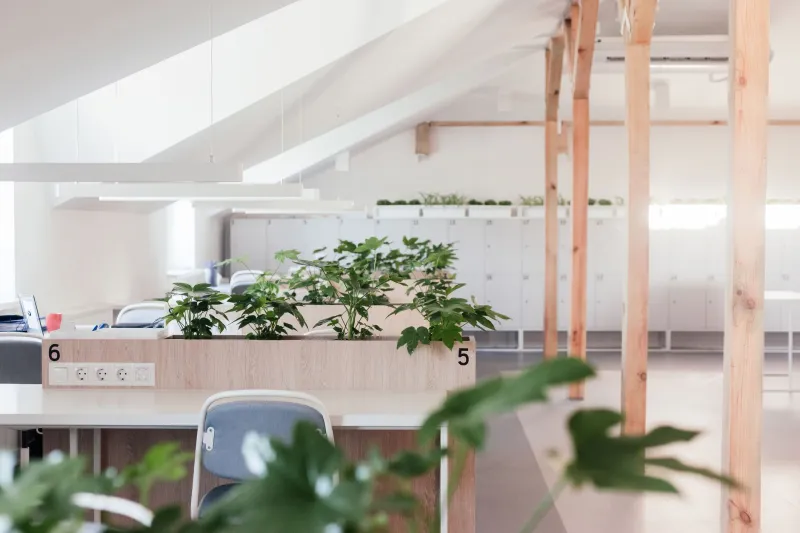
Teams do not need a permanent desk for every person, but they do need a recognisable base. This could be a small zone with a shared noticeboard, a locker bank and a standing table. The space should be bookable for team days and used consistently enough that people associate it with the team rather than with a particular individual.
Make handovers visible
Introduce a simple end-of-day or end-of-week handover note that is visible to the whole team. It need not be elaborate: three lines covering what moved, what is blocked and who needs to know. The purpose is to replace the informal desk-side update with something that can survive a change of seating plan.
Record the small decisions
Most teams record major decisions and forget the minor ones. In a flexible office, the minor decisions are precisely what get lost. A short decision log — kept in a shared document and reviewed at team meetings — can preserve the reasoning behind choices that would otherwise vanish when the desks are cleared.
Design for the handover moment
If people are not sitting together, the handover moment has to be designed. A fifteen-minute team check-in at the start or end of a shared office day can do more for memory than a longer meeting later in the week. The key is regularity and a clear purpose: what has changed, what needs to be remembered and who is carrying it forward.
Audit what the team has forgotten
Teams rarely notice memory loss until it causes a problem. A simple quarterly review can help: ask what the team has had to relearn, which contacts have gone cold and where duplicated work has appeared. These questions reveal the gaps that a desk booking system will never show.
A memory strategy, not a furniture strategy
The hot-desking debate is often framed as a choice between flexibility and fixed space. In practice, the more useful question is how a team maintains its shared memory when the physical anchors are removed. The team factor is not created by furniture, but it is often supported by the small routines and visible artefacts that furniture makes possible.
UK organisations do not need to choose between efficient offices and effective teams. They do need to accept that flexibility has a maintenance cost. Booking a desk may save space. Losing a team's memory costs time, continuity and, eventually, performance. The sensible response is to plan for both.